


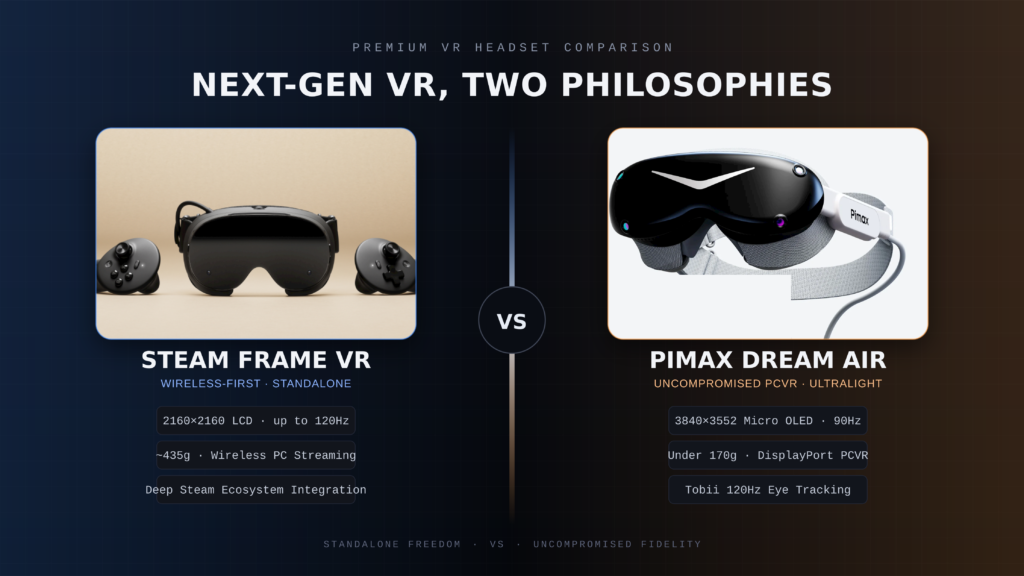
VR is about to get a lot more interesting. Valve’s Steam Frame is gearing up to challenge the established PCVR crowd, and Pimax isn’t sitting still either — the Dream Air is shaping up to be one of the most ambitious headsets the company has ever built. Both promise cutting-edge tech, but they’re chasing very different kinds of users.
Steam Frame is betting on flexibility: a wireless-first headset deeply woven into the Steam ecosystem. The Dream Air is making a different bet entirely — an unapologetic, no-compromises pursuit of visual fidelity, comfort, and raw PCVR performance.
If you’re trying to decide between the two, here’s how they actually stack up.
Steam Frame VR → store.steampowered.com/sale/steamframe
Pimax Dream Air → store.pimax.com/products/pimax-dream-air
At a Glance
| Feature | Steam Frame VR | Pimax Dream Air |
|---|---|---|
| Display | LCD | Sony Micro OLED |
| Resolution | 2160 × 2160 per eye | 3840 × 3552 per eye |
| Refresh Rate | Up to 120Hz | 90Hz |
| Field of View | 110° | 110° |
| Weight | ~435g | Under 170g |
| Tracking | Inside-Out | SLAM Inside-Out or Lighthouse |
| Eye Tracking | Supported | Tobii, 120Hz |
| IPD Adjustment | Manual | Automatic |
| Dynamic Foveated Rendering | Supported | Supported |
| Passthrough | Supported | Supported |
| Connection | Standalone + Wireless PC Streaming | DisplayPort PCVR |
| Image Signal | Streamed/Compressed | Native Uncompressed |
| Audio | Integrated Speakers | Integrated Spatial Audio |
Display Quality — Edge: Pimax Dream Air
This is where the gap opens up fast.
The Steam Frame’s 2160 × 2160 LCD panels should look plenty sharp for everyday gaming. But the Dream Air’s Sony Micro OLED panels are in a different league altogether, pushing a staggering 3840 × 3552 pixels per eye.
That’s not just a bigger number on a spec sheet — it translates directly into:
- Noticeably higher pixel density
- Crisper, more legible cockpit instruments
- Text you can actually read without squinting
- Sharper detail on distant objects
- True OLED blacks and far superior contrast
For sim racers, flight sim pilots, and anyone using VR for productivity, display quality is usually the single biggest factor in the experience — and here, the Dream Air isn’t close.
Comfort and Weight — Edge: Pimax Dream Air
It’s easy to get lost in spec sheets and forget that comfort is what actually determines how long you’ll want to stay strapped in.
The Steam Frame comes in around 435g, which is respectable by standalone headset standards. The Dream Air, though, weighs in at under 170g — a genuinely remarkable number for a headset with this level of hardware inside.
If you’re logging two, three, or four-hour sessions in iRacing, Assetto Corsa EVO, Microsoft Flight Simulator, DCS World, or Elite Dangerous, weight isn’t a minor detail — it’s the difference between a comfortable evening and a sore neck. On this front, the Dream Air looks poised to become one of the lightest premium headsets ever made.
PCVR Performance — Edge: Pimax Dream Air
The philosophical split between these two headsets shows up clearest here.
Steam Frame leans fully into wireless streaming and standalone play — a flexible approach that’s going to win over a lot of users. The Dream Air goes the other direction entirely, relying on a native DisplayPort connection that sends an uncompressed image straight from your GPU to the headset.
That gets you:
- The lowest latency possible
- Maximum image fidelity
- Zero compression artifacts
- Sharper clarity in detail-heavy games
- More consistent performance overall
Casual users may never notice the difference. But for anyone logging serious hours in demanding PCVR titles, DisplayPort is still the gold standard — and it shows.
Tracking and Expandability — Slight Edge: Pimax Dream Air
Both headsets ship with solid inside-out tracking, no external sensors required. But the Dream Air goes a step further by also supporting Lighthouse tracking, giving owners of Valve’s tracking hardware a precision upgrade path if they want it.
That hybrid setup makes the Dream Air a smart pick for newcomers and hardcore enthusiasts alike — start simple, upgrade later.
Eye Tracking and Future-Proofing — Edge: Pimax Dream Air
Both headsets support eye tracking and foveated rendering, but the Dream Air rounds out the package with:
- Tobii 120Hz eye tracking
- Dynamic Foveated Rendering
- Fully automatic IPD adjustment
Together, these make the headset both easier to use and lighter on your GPU. As VR titles keep pushing visual complexity higher, this kind of eye-tracking tech is only going to matter more — and the Dream Air looks ready for it.
Standalone Gaming and Convenience — Edge: Steam Frame
Here’s where Valve fights back.
Unlike the Dream Air, the Steam Frame is built to work standalone, with wireless streaming baked in. That means:
- Portable VR gaming, no PC required
- Total wireless freedom
- Deep Steam ecosystem integration
- True standalone operation
If you want one headset that works equally well on the couch and on the go, Steam Frame is the more versatile choice.
Sim Racing and Flight Simulation — Clear Winner: Pimax Dream Air
Simulators are arguably the toughest test in VR, demanding sharp resolution, rock-solid clarity, long-session comfort, minimal latency, and dependable tracking all at once.
The Dream Air checks every box. Sony Micro OLED panels, class-leading resolution, DisplayPort connectivity, Tobii eye tracking, and a featherweight build add up to one of the most exciting headsets on the horizon for serious sim enthusiasts — quite possibly the one they’ve been waiting years for.
Ecosystem and Software — Edge: Steam Frame
Valve’s software ecosystem is still one of gaming’s biggest advantages, and Steam Frame benefits from all of it:
- Native Steam integration
- Access to a massive game library
- Wireless PCVR functionality
- Full Valve software support
For anyone already invested in Steam, that convenience is hard to overstate.
The Verdict
These two headsets aren’t really competing for the same buyer — they’re built around opposite philosophies.
Go with the Steam Frame if you:
- Value wireless freedom above all else
- Want true standalone functionality
- Prefer an all-in-one, grab-and-go solution
- Live inside the Steam ecosystem
Go with the Pimax Dream Air if you:
- Want the best possible image quality, full stop
- Are primarily a PCVR user
- Race or fly sims seriously
- Want the lightest premium headset on the market
- Value visual fidelity over convenience
Overall Winner: Pimax Dream Air
Steam Frame may end up the more mainstream success story thanks to its standalone chops and Valve’s massive ecosystem — but on paper, the Dream Air is the more ambitious piece of hardware.
Micro OLED displays, class-leading per-eye resolution, an astonishingly light build, DisplayPort connectivity, Lighthouse compatibility, and top-tier eye tracking add up to a package that’s hard to argue with. For serious VR enthusiasts — especially sim racers and flight sim pilots — the Dream Air looks like the headset with the highest ceiling and the most exciting potential of the two.
My Hands-On Impression
I put the Lighthouse version of the Dream Air through about three hours of NASCAR Cup Series racing at EchoPark Speedway in iRacing (now near 30 hours), and the thing that stuck with me wasn’t the resolution — it was how quickly the headset stopped feeling like hardware at all. There was none of the usual pressure buildup, neck fatigue, or mid-session adjusting I’ve come to expect after a couple hours in VR. By the final stint I wasn’t thinking about the headset anymore, I was just racing, and that’s a bigger deal than it sounds. In close traffic, that trust extended to how I drove — I found myself running tighter alongside other cars than I typically would on a monitor, simply because I believed what I was seeing.
The visuals held up their end too. Braking markers, trackside references, and dashboard readouts all stayed sharp and easy to pick out at speed, with the kind of contrast and color you’d expect from a dual Micro OLED panel. What surprised me most is that Pimax didn’t have to strip anything out to hit that sub-170g weight — eye tracking, motorized IPD, integrated audio, and Lighthouse support all made the cut. My testing so far only covers the first few hours, and I’m curious whether that lightweight advantage holds up over a full endurance stint, but the early signs point to comfort mattering just as much as resolution once you’re a couple hours into a race. If you want the longer breakdown, I wrote up my full first impressions here.
Affiliate Disclosure: This article contains affiliate links. If you purchase through these links, SKSimRacing may earn a commission at no additional cost to you. Those commissions help support the reviews, testing, and content I create here on SKSimRacing.
Media Disclosure: SKSimRacing has permission from Pimax to use product images and promotional materials featured in this article.